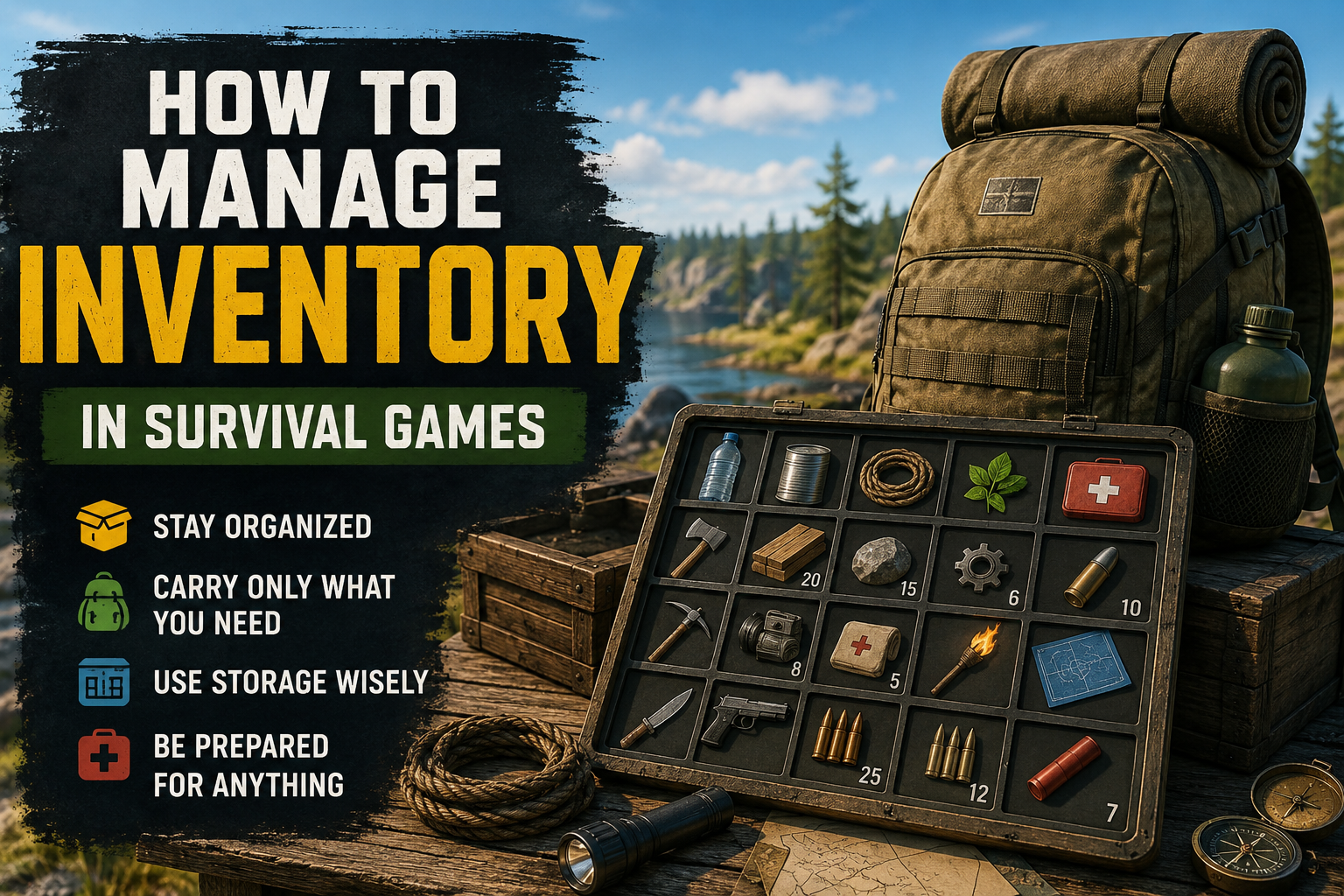
When I first started playing survival games, one of the things I found surprisingly difficult was managing my inventory. At first, I thought inventory management was just about picking up useful items and keeping them in empty slots. After playing more survival games, I realized that good inventory management can make a huge difference. It can help me survive longer, collect important resources, prepare for difficult situations, and avoid wasting time.
Survival games usually give players limited storage space. This means I cannot carry everything I find. I have to make decisions about what is useful, what can be left behind, and what should be stored at my base. In my experience, learning how to organize an inventory is almost as important as learning how to fight enemies or find food.
In this article, I will share the inventory management tips that I find most useful when playing survival games.
Understand What You Really Need
The first thing I learned was that not every item is worth carrying. When exploring a new area, it is easy to pick up almost everything because I think I might need it later. The problem is that my inventory quickly becomes full.
I now try to understand the difference between essential items and items that can wait. Food, water, basic tools, healing items, weapons, and materials needed for immediate crafting are usually more important. Random objects that I have plenty of at home can often be left behind.
Before picking something up, I ask myself whether I actually need it right now. If the answer is no and I already have plenty of it stored at my base, I usually leave it.
This simple habit saves a lot of inventory space.
Keep Important Items Easy to Find
A messy inventory can create problems when I am under pressure. If enemies are attacking and I need healing, I do not want to spend several seconds searching through a pile of random items.
I like to keep important items in predictable places. For example, I may keep weapons near one side of my inventory, food in another section, and healing items somewhere that is easy to reach.
The exact arrangement depends on the game, but the basic idea is the same. I want to know where everything is without thinking too much.
When I use the same organization every time, my hands almost remember where the items are. This becomes especially useful during combat or when I am exploring dangerous locations.
Do Not Carry Too Many Tools
Tools are important in survival games, but carrying too many of them can quickly fill my inventory.
If I am going on a short trip, I usually take only the tools that match my goal. If I am collecting wood, for example, I focus on the equipment needed for that activity. If I am exploring a cave, I take tools and supplies that are useful for underground exploration.
There is no reason to carry every tool I own unless I genuinely expect to use it.
I also pay attention to durability. A damaged tool may take up the same space as a fully usable tool, but it may not be worth keeping if I have another one available. In some games, repairing tools is easy, while in others it may require valuable materials.
Thinking about durability helps me decide what deserves an inventory slot.
Use Storage at Your Base
One of the biggest mistakes I made as a beginner was treating my inventory like permanent storage.
A good base should have organized storage. Once I started using containers, chests, cabinets, boxes, or other storage systems, inventory management became much easier.
I like to give different storage areas different purposes. One container can be for building materials, another for food, another for tools, and another for rare resources.
This makes it easier to find things later.
For example, if I need wood for building, I know exactly where to look. If I need food before an adventure, I can quickly open the food storage instead of checking several containers.
Good storage at the base also allows me to travel with a lighter inventory.
Avoid Carrying Every Valuable Item
Rare items can be exciting to find, but I do not always carry them around.
If I find something valuable while exploring, I usually think about whether I actually need it during the current journey. If it is a rare material that I only need for crafting at my base, I prefer to store it safely.
This is especially important in games where dying causes me to lose some or all of my carried items.
Losing ordinary materials is annoying, but losing a rare item that took an hour to find can be much worse.
For that reason, I try to return valuable resources to my base regularly instead of allowing them to build up in my backpack.
Plan Before Going on Long Trips
Inventory management starts before I leave my base.
Before going on a long exploration trip, I think about what I am planning to do. Am I looking for resources? Am I exploring a new region? Am I fighting enemies? Am I searching for a special item?
The answer affects what I bring.
If I am exploring, I may prioritize food, water, healing supplies, tools, and enough space for new resources. If I am going somewhere dangerous, I may carry better weapons and extra healing items.
Planning prevents me from filling my inventory with things that do not match my objective.
I also try to leave a few empty slots. This is one of my favorite inventory habits because it gives me room for unexpected discoveries.
Keep Emergency Supplies
I always like to reserve some inventory space for emergencies.
Survival games can change quickly. I might start exploring peacefully and suddenly encounter a strong enemy. I might become injured, run out of food, or find myself far away from my base.
Having emergency supplies can make the difference between surviving and losing progress.
Depending on the game, useful emergency items might include healing items, food, water, backup tools, or materials for creating a basic shelter.
I do not need a huge collection of emergency supplies. I just need enough to handle an unexpected situation.
Learn What Can Be Crafted Later
Another important inventory skill is understanding crafting materials.
When I first play a survival game, I often collect every material because I do not know what I will need. After learning the crafting system, I become more selective.
I check which materials are commonly used and which ones are rare. Common materials can usually be collected again without much difficulty. Rare materials deserve more attention.
I also avoid crafting everything immediately. Sometimes I collect resources first and decide what to craft after returning to my base.
This gives me more control over my inventory and prevents unnecessary crafting.
Use Stacking Efficiently
Many survival games allow similar items to stack in one inventory slot. Understanding stacking can make a huge difference.
For example, if one slot can hold many units of a material, I want to combine items whenever possible instead of leaving the same resource scattered across multiple slots.
I regularly check for duplicate stacks and combine them when the game allows it.
This small action can create several free spaces without throwing anything away.
It is also useful to understand stack limits. If a material has a maximum stack size, I know approximately how much space it will occupy before I start collecting it.
Drop Items Without Feeling Guilty
Sometimes the best inventory decision is simply dropping something.
I used to keep useless items because I thought I might need them someday. Eventually, my inventory became full of things that I had not touched for hours.
Now I am more comfortable letting go of items that are easy to replace.
If I have limited space and find something much more useful, I compare the two items. If the current item is common and the new item is rare or important, dropping the common item may be the better decision.
Inventory space is valuable, especially during exploration.
Organize Items After Returning Home
After a long adventure, I try not to leave everything inside my character’s inventory.
When I return to my base, I take a few minutes to organize my resources. I move materials into storage, refill important supplies, repair equipment when possible, and prepare for the next journey.
This routine may sound boring, but it saves time later.
A few minutes of organization can prevent several minutes of searching when I urgently need something.
It also helps me understand what resources I currently have. Sometimes I discover that I already have enough materials for a project and do not need to go collecting again.
Upgrade Inventory Space When Possible
If a survival game provides backpack upgrades, storage upgrades, or equipment that increases carrying capacity, I usually consider these upgrades valuable.
More inventory space does not automatically solve every problem, but it gives me more flexibility.
I can explore for longer, collect more resources, and carry extra supplies without returning home as often.
However, I do not depend completely on increased capacity. Even with a large inventory, poor organization can still create problems.
More space should support good organization rather than replace it.
Create Different Loadouts
Some survival games allow me to create different equipment setups. When available, I find this extremely useful.
For example, I might have an exploration setup, a combat setup, and a resource gathering setup.
Each setup contains items that match a specific activity.
This saves time because I do not have to rebuild my inventory from scratch every time I change activities.
Even if the game does not have an official loadout system, I can create my own routine by keeping certain items together.
Learn From Every Inventory Mistake
I think inventory management becomes better through experience.
Sometimes I take too much food. Sometimes I forget an important tool. Sometimes I fill my backpack with common materials and then find something rare with no space left.
Instead of getting frustrated, I try to learn from the mistake.
If I repeatedly run out of healing items, I know I should carry more next time. If I always return home with unused tools, I know I can reduce the number I take.
Every mistake teaches me something about the game.
Final Thoughts
Managing inventory in survival games may seem like a small part of gameplay, but I believe it has a major impact on the overall experience. A well organized inventory helps me explore more confidently, react faster during dangerous situations, and make better use of the resources I collect.
The most important lesson for me is that I do not need to carry everything. I need to carry the right things.
I try to plan each journey, keep essential items easy to access, use storage at my base, leave empty inventory slots, protect rare resources, and regularly organize everything I collect. I also pay attention to item stacking and learn which materials are actually worth keeping.
Once I developed these habits, survival games became much easier to manage. Instead of constantly worrying about running out of space, I could focus more on exploring, building, crafting, and enjoying the world around me.
Good inventory management is not about making the perfect decision every time. It is about creating a simple system that works for the way I play. With a little practice, even a limited inventory can be enough to handle long adventures and unexpected challenges.